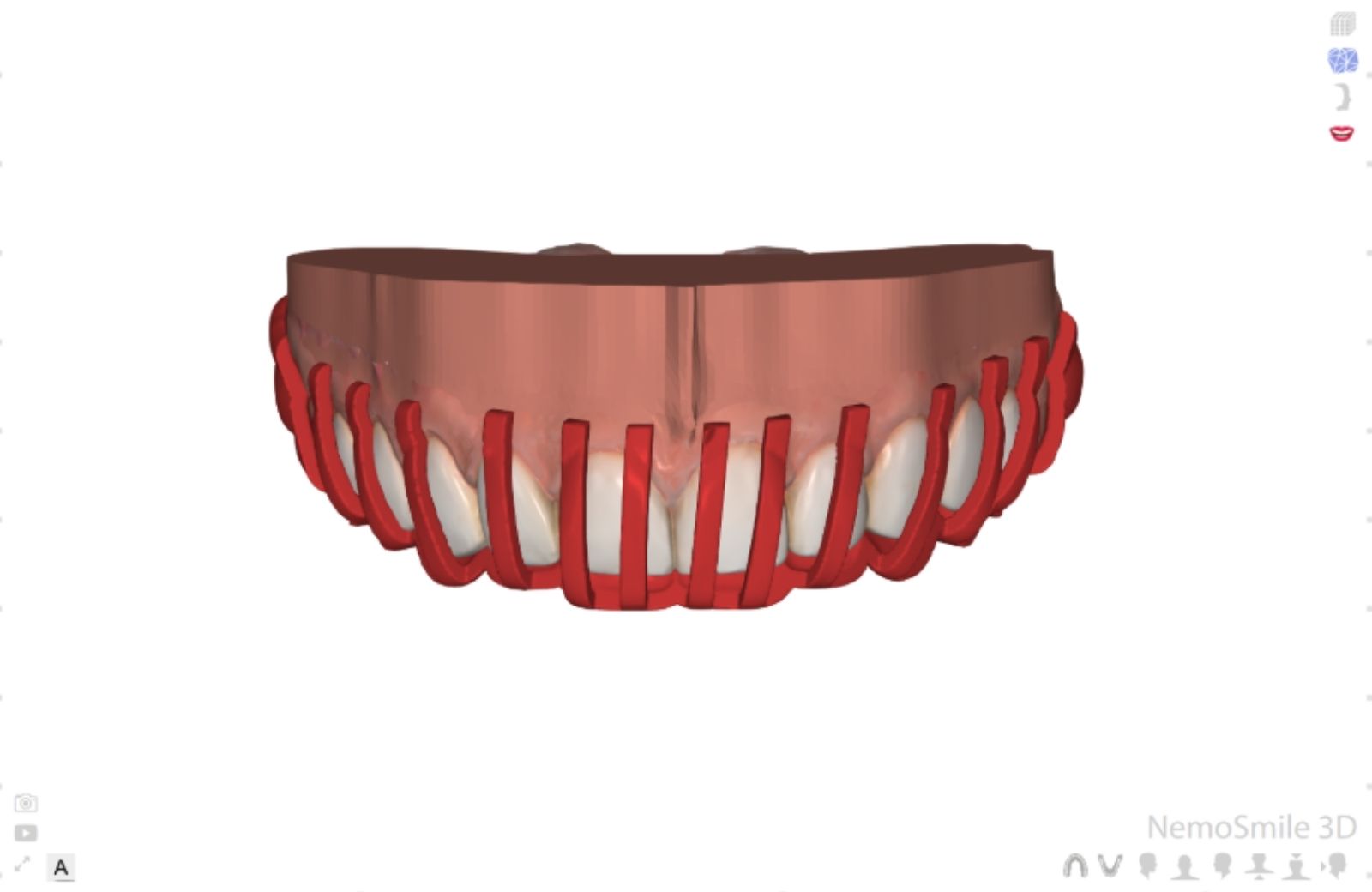
Digital dental wax-up is no longer a tool exclusive to the laboratory. In today’s clinical workflow, the clinician who designs the wax-up on screen is not simply fabricating a temporary restoration: they are making diagnostic decisions. They are determining proportions, lengths, symmetry, prosthetic emergence, and the relationship with soft tissues.
These decisions have direct consequences for tooth preparation, material selection, laboratory work, and the final in-mouth result. Making these decisions based on data—before any irreversible procedures are performed—is what distinguishes a predictable restorative workflow from one that relies on improvisation in the chair.
In this article, we explain how digital wax-up is integrated into restorative planning, which parameters it validates and which it does not, what the evidence says about its accuracy, and how we approach it in the workflow with NemoSmile.
What Is Digital Wax-Up and How Does It Differ from Analog Wax-Up?
Diagnostic wax-up is a three-dimensional simulation of the desired final result before any intervention on the tooth. In its analog form, the laboratory technician models in wax on plaster models. In its digital form, the clinician or laboratory designs on the STL model obtained from the intraoral scanner.
The goal is the same: to visualize and validate the treatment plan before committing to any preparation. What changes are the medium, the workflow, and the possibilities each method offers.
| Criteria | Analog Wax-Up | Digital Wax-Up |
| Medium | Wax on plaster models | CAD design based on STL |
| Modifications | Costly: require rework | Unlimited, with no material cost |
| Integration with manufacturing | Silicone printing → manual temporary | Direct export to a milling machine or 3D printer |
| Traceability | Difficult to document | Complete, reproducible digital record |
| Dynamic occlusal validation | Possible with a mechanical articulator | Possible with an integrated virtual articulator |
| Transfer to mock-up | Silicone key (technician variability) | Digital impression or direct 3D scan |
What digital wax-up does not automatically improve is the quality of the clinical decision behind it. The software executes what the clinician asks of it. If the records are incomplete or the prosthetic goals are not well defined, the digital wax-up will be faster to produce, but just as inaccurate.
At what point in the restorative workflow does digital wax-up come into play?
Digital wax-up does not occur at a single point in the restorative workflow: it can serve three distinct purposes, and confusing them is one of the most common mistakes.
- As a diagnostic tool. The clinician designs the final result and uses it to decide: How much reduction does this case require? Is it feasible without preparation? What occlusal discrepancies need to be resolved before milling? In this use, digital wax-up generates information for decision-making before taking action.
- As a communication tool with the lab. The STL file of the wax-up defines the parameters the technician must follow: lengths, emergence profiles, and the occlusal plane. It replaces verbal instructions and reduces variability in the final result.
- As a basis for direct fabrication. The digital wax-up can be exported to fabricate temporary restorations via milling or 3D printing, preparation guides, or digital silicone keys. In this application, the precision of the design is directly transferred to the physical material.
In each of these three contexts, the necessary records, the degree of occlusal validation required, and the approval criteria differ. A wax-up for communication does not require the same level of dynamic analysis as a wax-up intended for fabricating a long-term temporary restoration.
Which aesthetic parameters does digital wax-up validate (and which does it not)?
Digital wax-up precisely controls parameters that depend on geometry: dental proportions, lengths, bilateral symmetry, emergence profile, and relationship to the occlusal plane.
What it does not validate are the parameters that depend on the stomatognathic system’s response to changes: phonetics, comfort, tactile perception of thickness, and soft tissue reaction to the new contour. These parameters require an intraoral test, and that is the mock-up.
What the evidence says about bilateral symmetry:
One of the most common arguments in favor of digital wax-up is its ability to achieve greater aesthetic symmetry in the anterior region. A ) directly compared conventional diagnostic wax-up with 3D digital smile design (integration of facial scanner + intraoral STL) in 10 patients with 50 teeth analyzed.
The mean difference between the right and left sides was 2.33 mm with the conventional method and 2.61 mm with the digital method. The difference between the two was not statistically significant (t = -1.89; p = 0.07).
This does not invalidate digital wax-up. It places it in its proper context: a tool that achieves clinical symmetry comparable to the analog method, with advantages in traceability, reversibility, and digital communication that the analog method lacks. It is not inherently more symmetrical; it is more efficient and more easily integrated into the digital workflow.
Why Digital Wax-Up Needs a Virtual Articulator to Validate Function
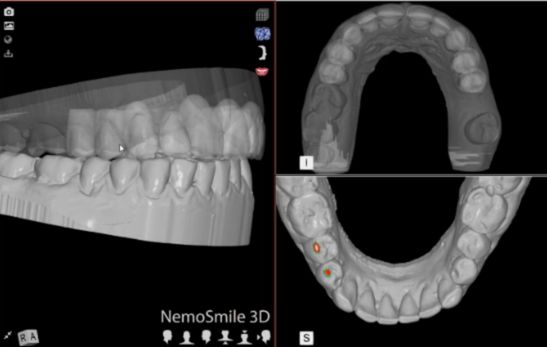
Static wax-up vs. dynamic occlusion: the difference that matters
Digital wax-up reproduces the shape of the teeth in the position of maximum intercuspation. That is static. What happens when the patient protrudes or performs lateral movements is dynamic, and the wax-up alone does not model this.
An aesthetically well-designed wax-up may have interferences in working or rocking movements that the clinician does not detect until the temporary restoration is in the mouth. At that point, the problem already has a clinical cost.
What the Integrated Virtual Articulator Offers
The virtual articulator reproduces the patient’s mandibular movements in a digital environment, on the model with the wax-up already designed. It allows the clinician to determine before fabrication whether the occlusal relationships during movement are correct, whether there are interferences during lateral movements, or whether the planned vertical dimension causes unwanted contacts.
A confirms that virtual articulators are more accurate and less time-consuming than mechanical articulators for dynamic occlusal analysis. Their integration into the digital restorative workflow improves the predictability of outcomes in complex cases.
When to Include It in the Plan and When It Is Not Necessary
A virtual articulator is necessary when the case involves a change in vertical dimension, anterior guidance correction, severe wear, bruxism, or complete oral rehabilitation. For anterior veneers with preserved morphology and stable occlusion, the dynamic analysis can be simplified or deferred to the intraoral mock-up.
The criterion is not one of convenience: it is one of clinical risk. The greater the occlusal complexity, the greater the need for dynamic validation before fabrication.
Errors in Transferring the Digital Wax-Up to the Clinical Result
A correct digital wax-up does not guarantee a correct in-mouth result. There is a series of steps between the on-screen design and the in-mouth temporary, and each step introduces variability. There are five most common errors.
- Incomplete or non-standardized records. An intraoral STL with poorly recorded occlusion or photographs lacking correct facial references prevent the design from aligning properly with the patient’s face. The wax-up may be geometrically correct but clinically incorrect.
- Mock-up fabrication method unsuitable for the case. A 2025 study (PMC12888098) compared the accuracy of conventional mock-ups, additive digital mock-ups (3D printing), and subtractive digital mock-ups (PMMA milling) in 14 patients indicated for anterior veneers:
| Method | RMS during the production phase | RMS for the entire process |
| Conventional | 0.13 mm | 0.22 mm |
| Subtractive (milling) | 0.73 mm | 0.51 mm |
| Additive (3D printing) | 0.76 mm | 0.60 mm |
The conventional method was the most accurate in production (p<0.001). The subtractive method outperformed the additive method throughout the entire process. Digital mock-ups, especially the additive ones, exhibit greater margin thickness and require intraoral adjustments. They are clinically viable, but the clinician should anticipate that they will require more chairside finishing than the conventional method.
- Occlusal validation omitted. Approving the wax-up based solely on aesthetic parameters without dynamic analysis is the most costly mistake in cases with a significant occlusal component.
- Unverified phonetics. When the design includes changes in incisal length or vertical dimension, phonetics change. The intraoral mock-up is the only stage in the workflow where this problem can be detected and corrected before it is incorporated into the final restoration.
- Confusing the wax-up file with the validated clinical result. The digital wax-up is a design proposal, not the validated result. Without an intraoral trial, there is no true validation.
How We Integrate Digital Wax-Up into NemoSmile
NemoSmile is NemoStudio’s smile design module. It integrates clinical photography, digital models in STL or PLY formats, and when the case requires it CBCT scans in DICOM format, all within a single aesthetic planning environment.
Input Data
The minimum records required for high-quality digital wax-up in NemoSmile are:
- Photographs: frontal view with maximum smile, frontal view at rest, profile view, and intraoral photographs. The facial alignment of the design depends on the quality of these records.
- STL model from the intraoral scanner: upper and lower arches in occlusion. An incomplete scan of the posterior sectors compromises the occlusal analysis.
- CBCT: when the case involves implants or there is periodontal involvement that affects the planned gingival contour.
Design Workflow in NemoSmile
The design is based on facial parameters: midline, smile line, and gingival exposure. The photograph provides the reference, and the STL model provides the volume. The workflow has two layers:
- 2D DSD: Alignment of the design with the patient’s photograph; definition of the smile line and lip relationship.
- 3D wax-up: volumetric design of the restorations on the digital model. Here, prosthetic emergence, free-surface profiles, and interproximal contacts are verified.
The result is the STL file of the wax-up, which can be exported to fabricate the mock-up (3D print or digital key) or sent to the lab as a fabrication reference.
Integration with Other Modules in the Workflow
In implant-prosthetic cases, NemoSmile’s digital wax-up integrates with NemoScan: the implant position is planned based on the emergence profile and prosthetic axis already defined in the wax-up.
In orthodontic-restorative cases, the integration is with NemoCast: the orthodontic setup and the restorative wax-up are aligned so that the tooth movements planned in orthodontics are consistent with the final prosthetic result.
Export for Manufacturing
From the approved digital wax-up, NemoSmile directly generates: – An STL file for manufacturing temporary restorations via milling or 3D printing – Gingivectomy guides when the case involves soft tissue management – Templates for veneers – Preparation guides based on the required reduction thickness
When to Outsource the Wax-Up Design to Our Team
Digital wax-up design requires time spent on software and clinical judgment. In high-volume clinics or in cases involving high aesthetic complexity, it makes sense to delegate the design to a specialized team.
From our planning center, we offer a dental aesthetics design service, which includes:
- 3D wax-up design based on the aesthetic and functional parameters defined by the clinician
- Digital mock-up or file export for fabrication
- Web viewer for reviewing and approving the design before fabrication
The clinician defines the objectives and approves the result. The team executes the technical design.
For cases involving high aesthetic complexity or requiring a multidisciplinary approach, the dental aesthetics planning service allows you to obtain an approved wax-up without spending time on software at the clinic.
Frequently Asked Questions About Digital Dental Wax-Up
When is a physical mock-up necessary in addition to the digital wax-up?
Whenever the case involves a significant change in incisal length, modification of the vertical dimension, or any parameter that affects phonetics or comfort. The digital wax-up validates the geometry; the intraoral mock-up validates the response of the stomatognathic system. They are complementary tools, not alternatives.
What records are essential for a high-quality digital wax-up?
Standardized clinical photographs (frontal, profile, smile, retractors) and an STL model from the intraoral scanner in correct occlusion. If the case involves implants, a CBCT is necessary to align the implant plan with the prosthetic result. A wax-up designed based on incomplete records produces unpredictable results.
Can the digital wax-up file be used directly to fabricate the temporary restoration?
Yes, when the wax-up has undergone a complete validation of occlusion, aesthetics, and phonetics. The STL file can be sent directly to a milling machine or 3D printer. In cases without prior intraoral validation, the temporary restoration fabricated from the wax-up should be considered a first approximation that will require chairside adjustments.
What is the difference between digital wax-up and digital smile design (DSD)?
DSD is an aesthetic planning methodology that uses facial photography and lip relationship to define treatment goals. Digital wax-up is the tool that implements those goals in three dimensions on the dental model. DSD defines the “what”; digital wax-up constructs the “how.” At NemoSmile, both layers are part of the same planning workflow.
How does the accuracy of digital wax-up compare to that of analog wax-up based on the evidence?
Conventional mock-ups show the highest accuracy in production (0.13 mm RMS). Digital mock-ups using the subtractive method achieve 0.51 mm RMS over the entire process, and those using the additive method achieve 0.60 mm RMS—both of which are clinically acceptable. The difference in bilateral symmetry between the digital and analog methods is not statistically significant (p=0.07). Digital wax-up offers advantages in terms of traceability, reversibility, and integration with the CAD/CAM workflow, with a level of precision that is clinically comparable to that of the analog method.