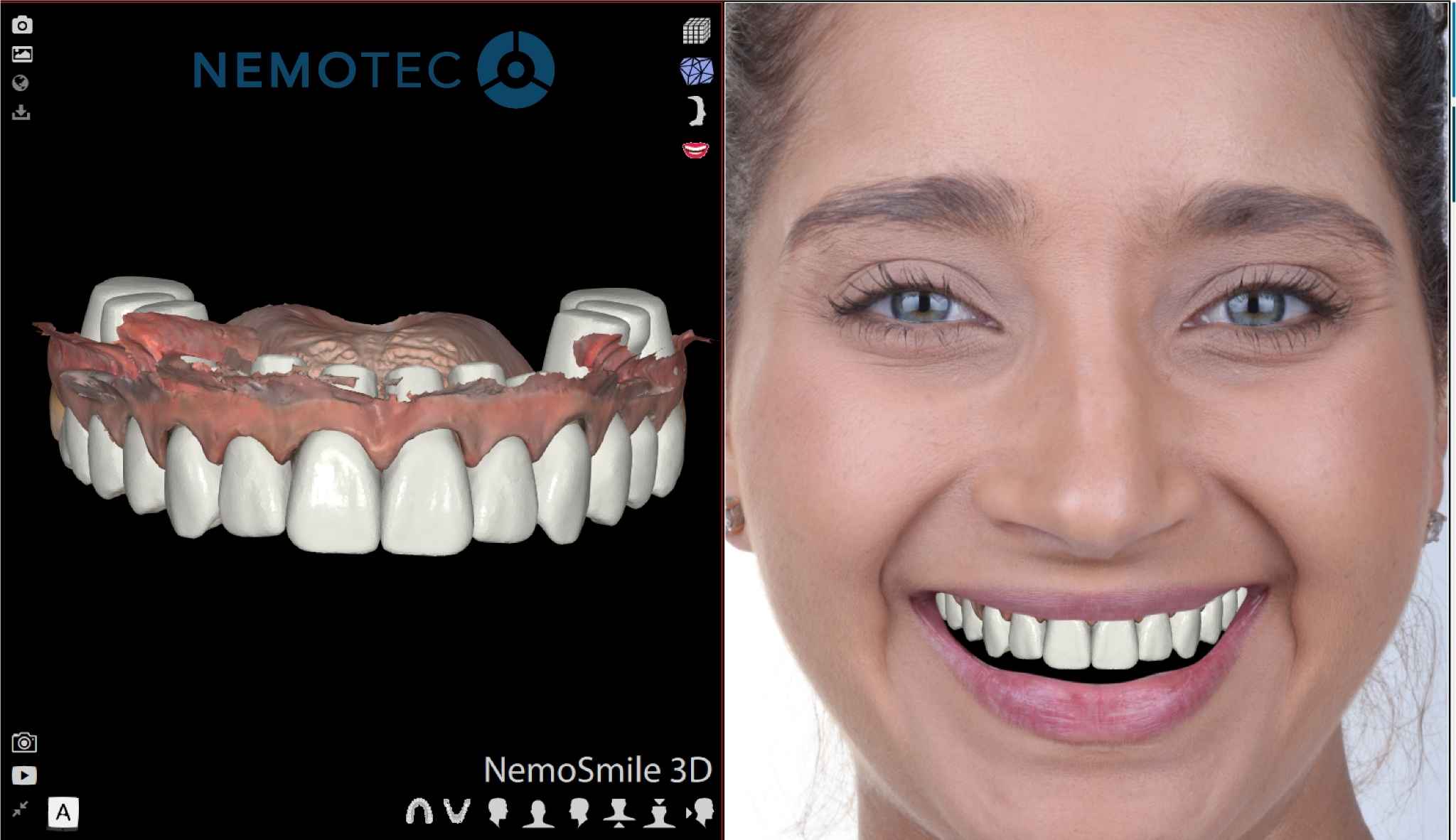
What is digital smile design and what is it used for?
In a professional setting, digital smile design is a set of protocols and tools that enable the modelling, validation and translation of an aesthetic-functional plan from the virtual environment to the clinic, with controlled tolerances. It is not limited to a photographic simulation: it integrates dental, gingival and facial parameters with occlusion and, where necessary, with bone volume (CBCT) to ensure the biological and functional viability of the result.
Main uses:
- Aesthetic-functional diagnosis: analysis of proportions, smile lines, buccal corridor and tooth exposure at rest/during speech.
- Restorative planning: definition of lengths/widths, emergence profiles and contours compatible with tissues.
- Clinic-laboratory communication: delivery of a virtual model with traceable references and measurements for mock-ups, preparation guides and temporaries.
- Teaching and internal auditing: versioning of the plan, “before → plan → result” comparisons.
To implement a digital smile design workflow in the clinic, check out digital smile design software.
Key concepts of digital smile design in clinical planning
- Facial landmarks: bipupillary plane, interpupillary line, midline, Camper’s plane and smile axis.
- Dental parameters: proportions (approx. 78–62–54 rule), relative width, gingival contour, zenith, contact points and black triangles.
- Function: anterior/canine guidance, occlusal scheme and contact control in protrusive/laterotrusive movements.
- Translation to the mouth: functional mock-up, preparation guides and temporaries aligned with the digital plan.
Relationship between facial, dental and functional aesthetics
Facial aesthetics define the framework, dental aesthetics adjust proportions and contours, and function validates that the design is stable under load. Any aesthetic proposal must pass through functional filters (occlusion, phonetics, habits) and biological filters (thicknesses, gingival biotype, bone support).
How digital smile design is integrated into a complete 3D workflow
A modern 3D workflow avoids inconsistencies between what is aesthetically pleasing and what is feasible. We work on a single virtual patient model that combines photography, intraoral scanning and, where applicable, CBCT.
- Photographic calibration and reference points
- Standardised quality photographs (resting, smiling, 3/4 view) and, if used, a facial scanner.
- Alignment of axes and reference points.
- Intraoral scanning (IOS)
- Capture of surfaces (teeth/gums), occlusion and bite registration.
- (Optional) CBCT
- Volumetric integration when changes affecting vestibular thickness, complex prosthetic emergence profiles or surgery are anticipated.
- Virtual planning
- Design and validation of lengths, widths, contours and contacts; functional guidance verification.
- Fabrication
- Functional mock-up, preparation guides and temporaries consistent with the plan.
From photography and scanning to virtual planning
The photo-IOS registration allows the facial frame to be superimposed onto the dental model and enables working with real measurements. When CBCT is incorporated, DICOM↔STL fusion prevents over-extensions or impossible contours and ensures emergence profiles and thicknesses compatible with biology and restorative mechanics.
To integrate this module with orthodontics, implantology and guided surgery within the same environment, check out the digital dentistry suite.
Real benefits of digital smile design in the dental clinic
- Predictability: the functional mock-up and preparation guides reduce the gap between plan and execution.
- Less rework: predictable adjustments through control of lengths, contacts and emergence profiles in the virtual environment.
- Coordinated multidisciplinary approach: periodontics, prosthodontics, orthodontics and implantology all work from the same reference.
Limitations, risks and best practices in the use of digital smile design
Limitations and risks
- Poor input: photographs taken without following protocol or incomplete scans render proportions invalid.
- Aesthetic-functional misalignment: a visually correct design may be unstable if occlusion/phonetics are not validated.
- Lack of volume: ignoring CBCT when there is a risk regarding vestibular thickness or complex emergence profiles can lead to overcontours.
Clinical recommendations
- Standardise data collection (photographic checklist and IOS).
- Validate function in the software (contacts, guides, simulated phonetics where available).
- Use a functional mock-up as an intermediate step and confirm with preparation guides.
- Finalise and lock the plan before fabrication; share the same reference with the laboratory.
Conclusion
The digital smile is a clinical methodology that connects aesthetics, function and biology in a single reproducible plan. The value lies not in a pretty photo, but in translating measurable decisions into mock-ups, guides and temporaries that maintain the design in the mouth. To accelerate adoption and standardise results, rely on digital smile design software integrated within a digital dentistry suite that unifies photography, IOS and, where applicable, CBCT under a single virtual patient.