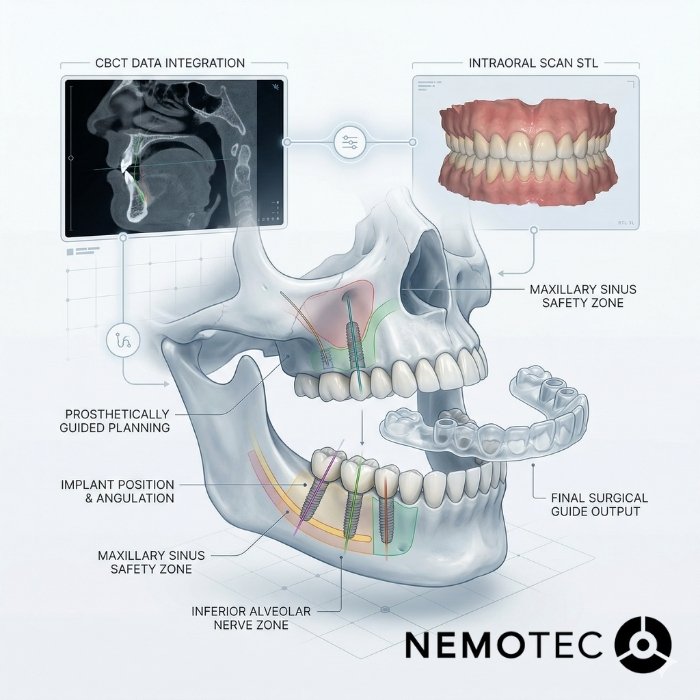
At Nemotec, we understand guided surgery for what it really is in clinical practice: a complete digital workflow that transforms records (CBCT + intraoral scanner + clinical data) into a more predictable, traceable and scalable surgical procedure.
The surgical guide is the “output”, but the value lies in the steps that come before: correct capture, alignment of records, prosthodontically guided planning, collaborative validation and controlled manufacturing. When this workflow is properly established, surgery ceases to depend on the inspiration of the moment and becomes part of a reproducible process.
What is guided dental surgery and how does it differ from freehand surgery?
Guided dental surgery: the placement of implants following a digital plan, executed using a guide that controls the trajectory (position, angle and, depending on the protocol, depth).
Freehand surgery: the procedure is carried out based on clinical/radiological landmarks and intraoperative monitoring, without any physical restriction on the trajectory.
One of the most important differences in practice is where the outcome of the case is determined:
- In freehand surgery, uncertainty is managed primarily in the operating room.
- In guided surgery, uncertainty is managed first: quality of the CBCT, quality of the scan, alignment of records, diagnostic wax-up, implant planning and guide design/manufacture.
And here is the key idea, explained without ambiguity: The guide does not correct errors; it carries them out.
If the CBCT and STL are misaligned, the guide will place the implant exactly where an incorrect plan specifies… with “perfect” precision.
That is why, at Nemotec, we place such a strong emphasis on validation: the aim is not simply to “make a splint”, but to ensure that the treatment plan has a sound clinical and geometric basis.
Who is guided dental surgery suitable for?
In our daily practice, guided surgery is indicated when you are seeking predictability across three dimensions:
- Anatomical (safety and margins).
- Prosthetic (emergence profiles, access, parallelism, final rehabilitation).
- Operational (equipment, timing, clinic-lab coordination).
In this context, the value increases when working within an open interdisciplinary ecosystem: the ability to integrate DICOM + STL/PLY + JPG + OBJ avoids silos and speeds up team decision-making (clinic ↔ laboratory ↔ planning).
Single, multiple and full-mouth rehabilitation cases
Single cases
Guided surgery is worthwhile here when the aim is not simply to place an implant, but to place it where the prosthesis requires it (emergence profile, screw access, parallelism with adjacent abutments) or when the anatomy demands a narrow safety margin.
Multiple cases
The value increases because the challenge is no longer getting just one right: it is ensuring that all are consistent for a predictable restoration. In multiple cases, small deviations accumulate and often result in additional work on the prosthesis (time, adjustments, angled solutions to salvage the situation).
Full restorations
This is where guided surgery typically offers the greatest operational return: prosthetic planning from the outset, coordination with temporary restorations, and the possibility of structuring advanced workflows (for example, immediate loading where the case permits). NemoScan incorporates “All-in-One” guides and immediate loading workflows within the implantology approach.
How to plan guided surgery step by step
Our view: if you want stable guided surgery, you need a workflow that is hardware-agnostic, with automation where it helps (e.g. segmentation) and clinical validation where it matters.
Preliminary tests: CBCT, intraoral scan and clinical records
Minimum quality requirements:
- CBCT (DICOM) suitable for the surgical objective.
- Intraoral scan which must include a complete and stable capture of the supporting surface (teeth and/or mucosa, depending on the type of guide), incorporating bite/occlusion records within the same workflow to correctly define the intermaxillary relationship.
Optional inputs (where the case requires):
- Photographs (JPG).
- Facial scan (OBJ) if you are seeking aesthetic/facial integration and advanced communication.
Digital planning of implant position, angulation and depth
This is where a professional distinguishes technically sound guided surgery from surgery that is merely apparently guided.
- CBCT–STL alignment (matching)
Geometric validation: it is not enough for it to simply look correct. The consistency of surfaces and anatomical landmarks must be verified. - Prosthetically guided planning
The implant is placed for the purpose of restoration; the surgery must serve the prosthesis, not the other way round. NemoScan is defined precisely by its integration of anatomical and prosthetic planning in implantology. - Anatomical safety + contingency plans
Margins, trajectories and clinical decision-making: if biology or mechanics do not allow it, the plan is adjusted or the indication is reconsidered.
And when the team needs to scale up without disrupting their schedule, the NemoStudio Planning Centre model allows you to outsource guided surgery planning whilst maintaining clinical control: you send records, our doctors plan, you review and approve via an online viewer, and you receive the digital and/or physical deliverable.
Design and printing of the surgical guide
The guide is designed for the real world:
- Type of support (tooth-supported / mucosa-supported / bone-supported).
- Stability and fit (without stability, there is no precision).
- Accessibility (mouth opening, distance, interference).
- Consistency with the surgical kit (sleeves/offsets/sequence) if the protocol is fully guided.
What happens on the day of surgery
If the workflow is properly carried out, surgery is more consistent. But our rule is simple: the clinic takes precedence. The guide does not replace surgical judgement.
Pilot-guided vs fully guided surgery
- Pilot-guided: for implant depth and angulation, a single drill is used.
- Fully guided: the guide accompanies the entire drilling sequence (and, in some systems, the insertion).
NemoScan incorporates both approaches within the implantology and guided surgery workflow.
When immediate loading can be considered
Immediate loading does not depend on the use of a guide, but on clinical and prosthetic criteria: primary stability, occlusal control, temporary restoration design, biology and risk.
What a well-organised digital workflow does facilitate is the alignment of surgery and prosthetics from the outset, particularly in integrated protocols that reduce the number of appointments and increase predictability.
Real benefits for the patient and the practitioner
Greater precision and anatomical safety
- Better control of trajectory and margins.
- Less intraoperative variability.
- Better traceability (very useful for documentation and teamwork).
Predictability does not come from software alone: it comes from unifying data and reducing silos, which is one of the pillars of NemoStudio.
Less invasiveness, shorter surgery times and better post-operative outcomes
In carefully selected cases, guided surgery can facilitate less invasive approaches and more efficient procedures. However, the protocol is dictated by biology and surgical visibility, not the existence of a guide: if the case requires a flap, regeneration (ROG) or intraoperative adjustments for safety and control, it is planned and executed in this way.
Better treatment communication thanks to 3D visualisation
For us, 3D is not just about planning: it is clinical communication. When the patient visualises the problem and the plan, resistance decreases and acceptance of complex treatments increases. At NemoStudio, this point is emphasised as part of the strategic impact of the workflow.
Frequently asked questions about guided dental surgery
Is it more invasive or painful for the patient than conventional surgery?
It depends on the case and the approach (tissues, duration, invasiveness). In well-indicated cases, it can facilitate conservative approaches, but this is not a guarantee in itself.
Does the workflow take longer?
Rather than taking longer, it shifts: guided surgery concentrates more pre-surgical work (capturing records, CBCT–STL fusion, planning and validation of the plan/protocol). In return, when properly executed, it reduces variability in the operating room and usually improves subsequent prosthetic efficiency.
What does guided surgery add compared with freehand surgery?
Unlike freehand surgery, guided surgery adds layers of work and control that are not present in a conventional workflow:
- Digital diagnosis and data capture: CBCT + intraoral scanning and, depending on the case, additional records (photos/face scan).
- Planning time: fusion of records, prosthetically guided planning, anatomical margins and definition of the protocol (pilot-guided vs fully guided).
- Design and manufacture of the guide: support/stability engineering, sleeves/offsets and production (printing or milling), with associated checks.
- Validation and coordination: internal reviews, clinic–laboratory communication and case documentation (traceability).