What is a virtual articulator?
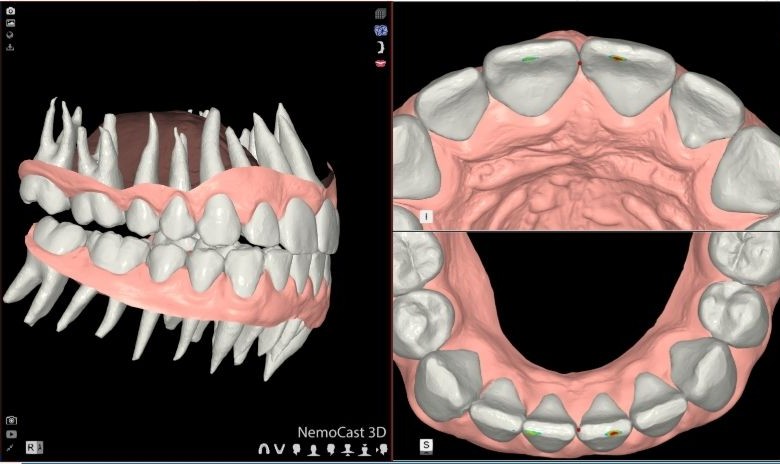
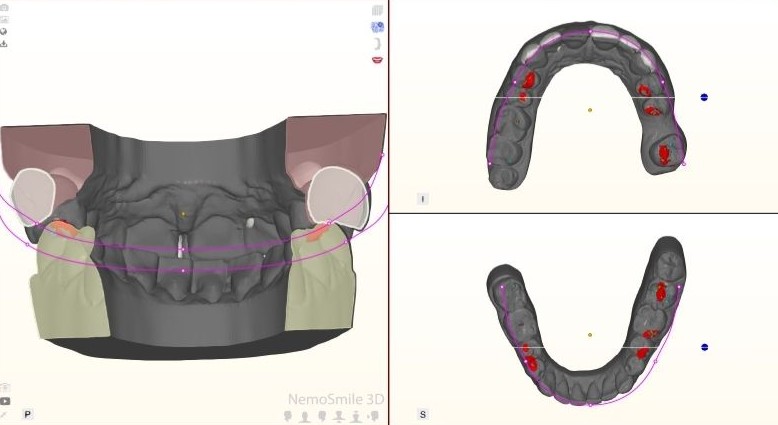
A virtual articulator is a software tool that uses 3D models of both dental arches to analyze occlusion by simulating mandibular movements and visualizing interproximal contacts and inter-arch distances. This information is typically presented through color maps and other graphical tools that simplify clinical interpretation.
At Nemotec, we integrate the virtual articulator into NemoStudio as a module aimed at evaluating occlusion in dynamics, facilitating digital planning and the documentation of findings within clinical-technical workflows.
At Nemotec, the virtual articulator is integrated into NemoStudio as an advanced solution for the functional analysis of occlusion, allowing for the evaluation of contacts and interferences during mandibular movements and providing key information for more precise and predictable treatment planning.
The value of a virtual articulator in a professional setting
Whether in the clinical environment (patient-facing) or the technical environment (dental lab/CAD-CAM), the competitive advantage of a virtual articulator is the shift from static occlusal verification to a functional and reproducible analysis, offering clear benefits:
- Dynamic assessment: Analysis of contacts and interferences during excursive movements, beyond maximum intercuspation.
- Enhanced communication: improves collaboration between clinical and technical teams by sharing a common visualization of the case and the proposed solution, rather than relying on subjective descriptions.
- Case traceability: Parameters, screenshots, and revisions can be saved for internal audits or follow-ups.
- Interdisciplinary support: facilitates complex workflows (rehabilitation, orthodontics, implantology, orthognathics), especially when the maxillo-mandibular relationship dictates the treatment plan.
What can our NemoStudio Virtual Articulator do?
1) Simulating mandibular movements for occlusal analysis
At Nemotec, have designed this module to simulate mandibular movements, allowing you to observe how contacts evolve throughout the movement and supporting the analysis of guidance and interferences in dynamic scenarios.
2) Defining and managing articulator control points
Our workflow is based on defining reference points and mounting parameters equivalent to those used in conventional articulators. These elements establish the spatial position of the models and configure the simulation of mandibular movements. This stage allows the virtual articulator to be adapted to the available data for each case and specific team protocols.
3) Adjusting articualtor parameters
Configuring articulator parameters allows for the customization of occlusal simulation according to each case´s needs. Simultaneously, it promotes the application of common protocols within the team, improving consistency in analysis and clinical decision-making.
4) Practical applications in digital planning
At Nemotec, we focus the virtual articulator on practical use cases where accuracy is required:
- Dynamic occlusal analysis
- Planning in a desired maxillo-mandibular relationship
- Splint design.
Common indications. When is it most useful?
Without replacing clinical judgment or diagnostic protocols, a virtual provides particular value in:
- Complex rehabilitation and occlusion: Validating contacts and guidance dynamically before finalizing designs.
- Digital orthodontics: Reviewing contacts/interferences during setup planning.
- Implantology: Checking occlusal relationships and functional constraints within the global plan.
- Orthognathic: Analyzing the occlusal impact of maxillo-mandibular changes in a simulation environment.
Recommended Workflow (Operational Vision)
A simple, consistent, and standardized workflow can be structured as follows:
1. 3D Model Preparation
Verification of integrity, trimming, alignment, and initial arch relationship.
2. Virtual Articulator Configuration
Definition of control points and parameterization according to team protocols.
3. Simulation and Reading
Systematic review of contacts in static positions and during excursive movements, with interferance identifiaction.
4. Plan iteration
Adjustments in design/restoration/setup followed by dynamic re-validation until the objective is met.
5. Documentation and Communication
Generating visual reports through snapshots and graphical representations of the occlusion to facilitate case review and clinical-technical coordination.
Clinical best practices and considerations
- Simulation reliability: Analysis accuracy depends directly on the quality of digital records, correct model alignment, and the validity of the maxillo-mandibular relationship used.
- Managing multiple occlusal records: When multiple records are available, comparative analysis is recommended to better understand the patient´s functional situations.
- Standardized protocols: Establishing common criteria for articulator configuration and results interpretation fosters consistency across cases and operators.
- Traceability: Retaining used parameters and relevant study images facilities future revisions and collaboration between professionals.
Frequently Asked Questions
1) When should articulator parameters be adjusted versus standardized?
Individualization is particularly useful in complex rehabilitation, vertical dimension changes, orthognathic planning, or splint design. In routine cases, standardized parameters can improve reproducibility among operators.
2) What communication gaps does it reduce between the clinical technical team?
It minimizes ambiguities regarding the location of a problem, the exact movement phase where it occurs, and the expected outcome after adjustment. By working on a shared, documentable visualization, subjective interpretations are reduced.
3) In what cases is especially useful for splints?
It adds value precise contact distribution is required, helping define guidance according to the therapeutic goal and maintaining documentation for future follow-ups and modifications.
Ready to upgrade your digital workflow?